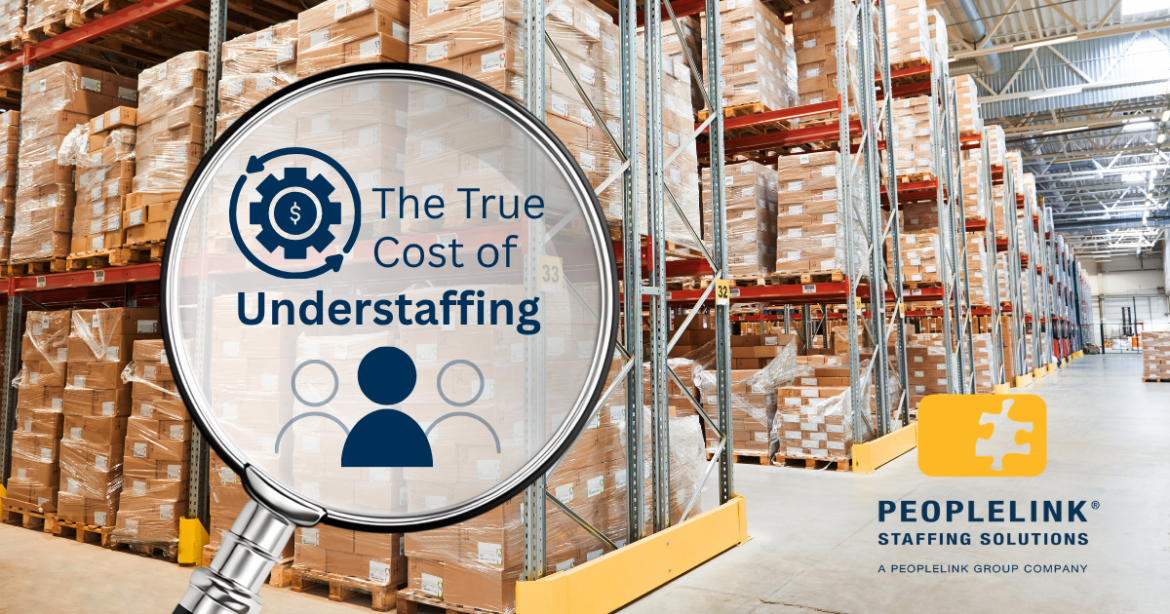
April Fools’ Day has come and gone, but there’s a mistake businesses make year-round that’s no joke: underestimating the cost of understaffing. Operating with fewer workers might look like a smart way to control labor spend on the surface. But the reality is that it often costs far more than the positions you thought you were saving.
In fact, according to Gallup research, when employees are asked what they view as the greatest barrier to delivering top-notch products and services to customers, staffing shortages is cited the most.
The Visible Costs Are Just the Beginning
When a shift is short-staffed, the immediate impact is obvious: slower throughput, rushed pick-and-pack operations, and supervisors filling in where they shouldn’t have to. Orders get delayed. Customers notice. But the financial damage goes well beyond a bad shipping day.
According to BOSTONtec, labor consistently accounts for 50 to 70 percent of a company’s total warehousing budget. That means every hour your team is stretched thin — rushing to compensate, cutting corners, or burning through overtime — is an hour that’s costing you more than it should when overtime is the only lever to pull.
It’s easy to think about overtime as just a line item, but it’s also a signal. When it becomes a regular workaround for understaffing, it stops being a solution and starts becoming the problem.
Burnout Drives Turnover — And Warehouse Turnover Is Expensive
And teams that are stretched too thin have other consequences. Chronically understaffed environments put enormous pressure on the workers. They absorb extra work, pick up missed shifts, and push through exhaustion to keep operations moving.
Warehouses running perpetually short are prime environments for disengagement which soon leads to departures. Workers start looking for the exit door. Now the expenses become more visible: recruiting, onboarding, and the productivity gap while the new hire ramps up all come with a price tag. For operations managing dozens of floor-level roles, that math adds up fast.
But turnover is only part of the equation. Which workers tend to leave paints a broader story.
The Hidden Cost of Understaffing: Your Best People Won’t Stick Around
Here’s where understaffing gets especially damaging because two common scenarios start feeding each other.
When conditions stay difficult for too long, you typically see two types of attrition. One, disengaged workers begin to quietly withdraw and eventually walk out, creating open roles that add pressure to everyone else. Not only that, but often more problematic, your top performers start making the same calculation.
Gallup research makes this dynamic explicit: highly talented employees who are disengaged leave at rates on par with low performers who are unhappy. Why? Because your best people have higher expectations of their workplace and, critically, more options. They’re not going to wait it out. They seek out environments where their contributions are recognized, and their effort isn’t constantly compensating for a headcount gap someone above them hasn’t filled.
And that’s a problem. According to Salary.com, a recent study shows that highly engaged employees are 18% more productive than their less engaged peers.
That compounding effect is what makes the cost of understaffing so quietly destructive. The first wave of turnover makes conditions harder. Harder conditions push your strongest team members toward the exit. And each departure leaves a deeper knowledge and productivity hole than the last. What begins with “just filling roles” can turn into a vicious cycle of rebuilding capability from the ground up, repeatedly.
Workforce Planning Is the Real Cost Control
When a warehouse is short on labor, the cost shows up everywhere: in overtime premiums, error rates, customer service failures, and the steady drain of institutional knowledge walking out the door. The difficult truth is that the cost of understaffing is nearly always higher than the cost of being properly staffed — it just tends to hide in places that don’t show up on a single budget line.
Proactive workforce planning, which can mean building a stronger bench through a staffing partner, cross-training for flexibility, or adjusting hiring timelines ahead of demand spikes is a smart form of risk management.
The most resilient operations teams we work with don’t staff to the minimum. They staff to a standard that lets their people do their best work, sustain it over time, and stay.
Ready to right-size your workforce before it becomes a problem? Peoplelink Staffing works with warehouse and light industrial operations to build flexible, reliable teams — whether you need to fill gaps quickly or plan ahead for peak demand. Connect with our team to start the conversation.