A career doesn’t necessarily begin with a long-term plan.
Sometimes it starts with a job you take while figuring out what comes next. It may be an opportunity to enter a new industry, build experience, learn new skills, or get back into the workforce. And sometimes, a temporary assignment turns into a permanent position you never expected.
That’s one of the things worth remembering about temporary and contract work: a job with a defined assignment can still become part of a much bigger career story.
A few weeks ago, we celebrated National Staffing Employee Week, where we recognized the people who bring their skills, flexibility, and determination to workplaces every day. Their assignments may have a defined end date, but the experience they gain can continue to serve them long after the assignment is over.
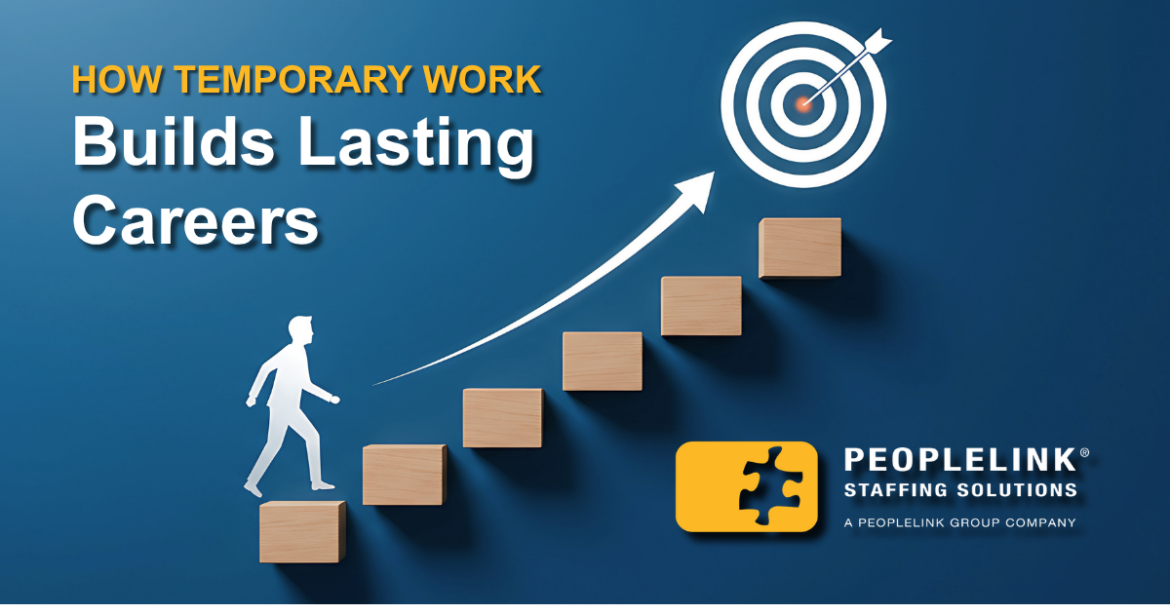
Let’s look at how temporary work builds lasting careers and contributes to a progressive career path.
A Temporary Job Can Open a Permanent Door
For some workers, temporary employment is a way to get started with an employer and demonstrate what they can do. Unlike a traditional hiring process, a temporary assignment gives both the worker and the employer an opportunity to evaluate the fit through actual experience.
A résumé can describe someone’s skills, and an interview can provide a snapshot of their experience. But a temporary assignment can show how those skills translate to the workplace: how someone learns a process, works with a team, responds to challenges, and takes responsibility for their work.
The U.S. Bureau of Labor Statistics has described temporary jobs as an important “port of entry” to permanent employment from the candidate’s perspective. Temporary agencies can also give employers an opportunity to evaluate potential hires before making a permanent commitment.
That creates an opportunity on both sides. A worker gets the chance to gain experience and demonstrate their abilities. An employer gets to see a person’s skills, work ethic and potential in action.
When the fit is right, a temporary assignment can become a permanent career.
But permanent placement isn’t the only measure of a successful assignment.
Every Assignment Adds to Your Career Capital
Even when a temporary job doesn’t lead directly to a permanent position, it can still leave you better prepared for what comes next.
A new assignment might mean learning to operate different machinery, gaining experience with another production process, becoming familiar with new quality or safety procedures, or developing skills that make a future opportunity possible.
It can also build something less tangible but equally valuable: career capital.
Every assignment gives you another experience you can point to when pursuing your next opportunity. You may be able to demonstrate that you’ve worked in different environments, learned new processes quickly, adapted to different teams, or taken on responsibilities you hadn’t handled before.
Over time, those experiences can expand the types of roles you are qualified for and confident pursuing.
This is where adaptability becomes particularly valuable.
According to U.S. Bureau of Labor Statistics data, adaptability ranks as the top skill across all occupations. BLS defines adaptability as adjusting work methods in response to new information or changing conditions, being open to change and actively learning.
Adaptability can be developed through formal training. But it is often built through experience.
Moving into a new assignment can require you to learn a different process, adjust to a new supervisor or team, understand new expectations, and become productive in an unfamiliar environment. Each transition gives you another opportunity to practice learning and adjusting on the job.
Those experiences become part of your professional toolkit, giving you more to draw on as your career evolves.
Temporary Work Can Help You Make Better Career Decisions
Career decisions are often made with incomplete information. A job description can tell you what a position requires, but it can’t fully tell you what it feels like to work in that environment, with that type of team, or at that pace.
Temporary assignments can provide firsthand information before you make a longer-term commitment.
Maybe you’ve worked in one type of manufacturing and want to see what another environment is like. Maybe you’re considering a new career path but aren’t sure where your experience fits. Maybe you’re returning to work and want to rebuild your experience before committing to a long-term position.
An assignment gives you an opportunity to experience the work rather than simply imagine it.
You can learn what you enjoy, where your strengths fit, and what kind of workplace suits you. If the work is a good match, you may discover a direction worth pursuing. If it isn’t, you still leave with useful information about what you want from your next opportunity.
Either way, the experience helps inform your next decision.
There Is No Single “Right” Career Path
Career journeys are rarely as neat as they look on paper.
One person may start as a temporary production associate and eventually become a full-time employee. Another may take several assignments while deciding which type of work is the best fit. Someone else may use temporary work to build experience between permanent jobs.
Career progress doesn’t always look like a straight line.
Progress can mean learning a new skill, discovering an industry that fits, gaining confidence with greater responsibility, or finding an employer where you can build a long-term future.
The value of an assignment isn’t limited to what you earn while you’re there. It’s also what you leave with.
Every job can add another skill to your toolbox. Another experience to your résumé. Another professional connection. Another piece of information that helps you understand where you want to go next.
Those things add up.
Your Next Opportunity Could Be Part of a Bigger Story
At Peoplelink Staffing, we’re proud of the temporary, contract and direct-hire employees who make an impact in the workplaces we serve.
We know that when someone accepts an assignment, they’re bringing more than a résumé with them. They’re bringing goals, experience, potential, and a story that is still being written.
National Staffing Employee Week was a chance to recognize that contribution and celebrate the many paths’ people take to build their careers. But the value of that work extends far beyond one week. We see every day how the right opportunity can become an important step in someone’s career.
What You Take with You Matters
Your next assignment may give you more than a paycheck. It could give you new skills, valuable experience, a professional connection, or a clearer idea of where you want to go next.
Explore current opportunities with Peoplelink and see where your next assignment could take you.